Why should students really think that 4.3 is larger than 4.299999999?
Ordering decimals is very counter-intuitive for most students.
As a result, teachers often have to resort to:
- Teaching rules which seem arbitrary to students and do not produce understanding
- Using a number line to try and illustrate relationships--but this may seem arbitrary to students
Supermath’s Solution
Create a setting in which students try to capture an evil crooked decimal by searching a variety of locations whose addresses are decimals.
Supermath provides clues to help students develop a sense of the properties of decimals on their own.
Curriculum
The curriculum guide (PDF) starts by telling teachers which level the software should be set to.
Students are asked to draw what they think an evil decimal will look like.
Students are told that the addresses in the hood get larger as they search to the right as they are going uptown.
Software
Presents students with their first view of the hood they will be searching. In the example below the hood is a street with buildings whose addresses are 7.0 to 8.0.
Students enter their first address of 7.8 and get their first clue from an obviously law abiding decimal, as seen on the right.
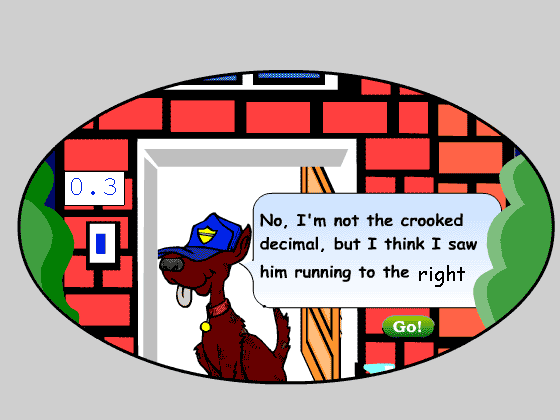
Students eventually discover that the address where Carmen is hiding is to the right of building 7.8 and to the left of building 7.9. How can that be?
Step 4: Oooops-Students Encounter the Alley
The clues eventually guide students towards an address between buildings 7.8 and 7.9 as shown on the right.
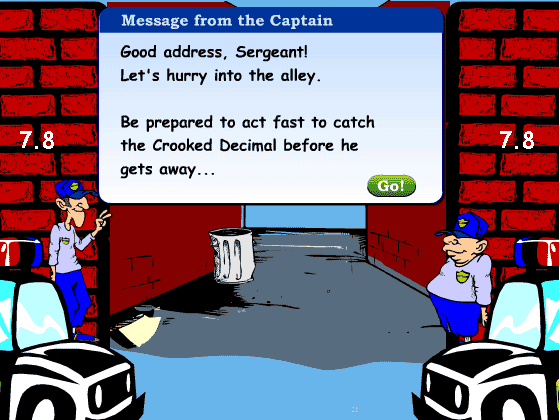
At this point, many students have no idea how to construct a decimal in-between these two addresses regardless of how long they have worked with decimals.
Step 5: Alas, Carmen has escaped deeper into the Hood
Alas, Carmen has escaped to one of the garbage cans between 7.80 and 7.90, and chose one that is to the right of 7.85. Where do you think she is hiding?
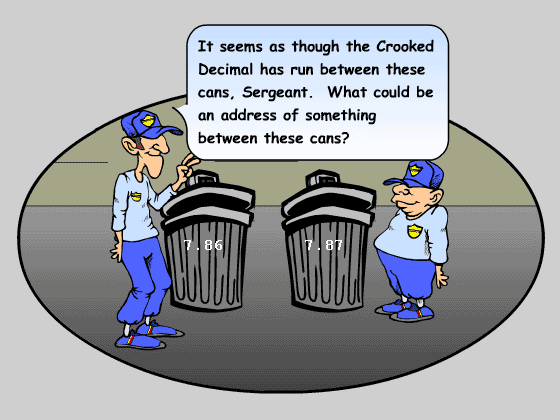
Students use the clues to discover that Carmen has fled between the two garbage cans, 7.86 and 7.87.
Is there a valid address between these two cans? What could it be?
Possible answers include 7.861-7.869
To see what happens if you enter a valid address between these two cans, e.g., 7.865…
….Hurry to the next slide to see which mouse hole Carmen has escaped to!
Step 6: Hurry... Capturing Carmen
Carmen is indeed hiding in a mouse hole section of the hood, specifically a hole with an address between 7.860 and 7.865. Hurry!!!

In this case, if you hurry you will find her hiding at 7.863.
To see what the evil crooked decimal looks like and see the capture….
Step 7: Developing Math Skills
To this point students have had fun playing a game. So what? Where is the math? This is where the classroom teaching comes in!
Curriculum Extensions
The curriculum first gives students problems to determine which of two given addresses are larger, and asks them to use their experience with the game to justify each answer.
In other words, when comparing 4.3 and 4.299, students will respond that 4.3 is larger because to get to 4.299 you have to go in the alley between 4.2 and 4.3, and 4.3 is to the right, so it is the larger address.
Students are then asked to review the earlier problems, and to look for patterns in their answers. The goal is to discover a math rule that someone else who does not have access to the game can use to determine which of two addresses/decimals is larger.
Students then infer the rule of looking to the right of the decimal and seeing which digit is the largest in the first decimal place.
Step 8: Developing Math Understanding
In other words, the game provides a mental model for students to infer a key math rule on their own.
Instead of giving the students the math rule--they end up discovering it. This inference is made possible by the game which is in fact an intuitive metaphor of a 3D number line.
The curriculum then has students use the game metaphor to figure out answers to the following reasoning questions:
- If you were to design the game for four decimal places, how
would you do that?
(Possible answer: Place 9 insect holes between each mouse hole.) - What is the pattern between the addition of decimal places and
the nature of the spaces described by the addresses?
(Ans. They got smaller.) - If you were designing a bridge, would you use a few or many
decimal places on your measurements?
(Ans. Many decimal places for greater precision.)
The amazing thing is that students who always struggled with math or hated it are as likely to come up with the answers as anyone else.
This turnaround results from Supermath enabling teachers to provide a context that students can use as an intuitive basis for reasoning.